Monday, 28 March 2011

Niodori Park - Misato

I spent a couple of hours birding at Niodori Park this morning. I was primarily after a good clean shot of a wagtail but they were hard to find today. The wagtails were surprisingly hard to find today but I made up for it with a couple of new species. So all in all it was a good morning.


White Cheeked Starling
 A relatively common visitor to the park.

Daurian Redstart (female)
I believe this is a Daurian Redstart female but I'm not 100% on identification here. The male is very colourful but I didn't see any males around.


Oriental Greenfinch
 Another first sighting species, a pair of Oriental Greenfinches. They were hard to photograph since they didn't like me getting too close. This image is cropped more than I would like. I probably need 800mm or more of reach for these guys.


White Wagtail (ssp. lugens)
These guys were the purpose of my outing but only showed up as I was leaving and didn't hang around long either. The other day I got a reasonable shot with just 35mm of focal length. Today I needed all 400mm and a cropped sensor camera.

Wednesday, 23 March 2011

First Impressions - 5D MK II

After humming and harring about buying the 5D mk II now or waiting for the next generation full frame camera, I finally pulled the trigger and bought one. I also got the 24-105mm kit lens which I was just as excited about since I have been after a standard travel zoom and all the cropped camera options left something to be desired.

On full frame this lens is
  • Wide enough for landscapes
  • Long enough for portraits
  • Weather sealed
  • Image stabilised
  • Constant aperture zoom
  • Shallower depth of field relative to cropped alternatives 
Seriously, what's not to like about it.

Anyway, it arrived early this morning and since this camera uses the same battery as the 7D I threw in a fresh one and immediately took it out for a field test.


Choco-chan

Before I even left the house this test subject, came around. A neighbourhood cat we've come to call Choco-chan. I like the shallow DOF here.


White Wagtail

While 105mm is not what I would usually choose to photograph birds, I thought I would see what it can do anyway. This image is about a 75% crop but still shows great detail for a web image. One thing becomes quite obvious with the camera is the lack of a built in fill flash to add that catch light to the eye.


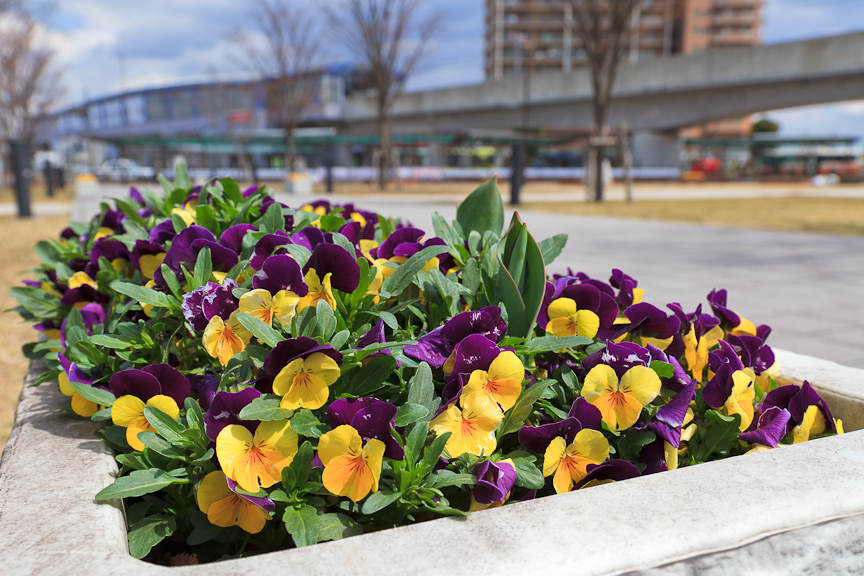
Purple and yellow pansy flowers

The shallower depth of field will take a little adjusting to. I was going for a slightly out of focus station in the background but this is a little more than I expected even for f/8.0. Looks like a great subject for a tilt-shift lens.


Tsukuba Express entering a tunnel

I took a trip to Akihabara, Tokyo to get a few supplies (protective screens, filter and flash sync cable) for the new camera and lens. While riding the train I took the opportunity to try some photography from the last car as we entered a tunnel. You won't be able to see this in a web compressed jpg image but this was at ISO 800 and the noise is so much less than my 7D.


Tsukuba Express in a tunnel

This is a 5 second exposure at f/4.5 and ISO 800. Again the noise is very well behaved and although it's hard to prove, I'm hoping that image stabilisation is helping to keep the image smooth and "together".

So for my first day out, I'm very happy with the camera and lens. I must admit I am left wondering why I didn't buy it sooner. I almost bought another 7D with the Canon EF-s 15-85mm f/3.5-5.6 IS USM lens, but now I'm so glad amazon was out of stock and I cancelled my order. For what works out to being just 50% more, I have a much better camera and walk around travel lens. I should be able to recover some of that cost by selling some old EF-s lenses too.

Friday, 11 March 2011

Snow Monkeys

Today I took a trip to Nagano to photograph the world famous Snow Monkeys of Japan.

These are some of the most northern primates (except humans) that live in a cold harsh environment. A few years ago they discovered that onsens were warm and they started relaxing in them through the long winter months. In these parts of Japan there is snow on the ground for about 4 months of the year.

These monkeys are wild and live in the mountains near by but are very used to tourists and photographers around them. As such we can get really close to photograph them.


Cold Day


This is why they are called Snow Monkeys.


Their Onsen

When it's really cold, lots of monkeys will get into the onsen. This was taken shortly after a snow shower.


Young Snow Monkey

This little cutie was making several strange sounds and facial expressions.


Grooming, a never ending task


Finally some nice lighting


Sunday, 23 January 2011

Birding in Taiwan

I recently spent 5 days sightseeing in Taiwan. I didn't really plan to do any birding while I was there. However while walking around I observed several species I'd never seen before so I did my best to capture them on digital. I was using a Canon EOS 7D with the new EF 70-300mm f/4.0-5.6 L IS USM lens giving me about 480mm EFL. It's a great travel lens but perhaps not the best for birding, none the less I thought it performed quite well.


Red Turtle Dove


Night Heron (adult)


Night Heron (juvenile)

 Etsuko spotted this one in the trees above us while I was busy photographing the adults in the pond.


Chinese Bulbul


Grey Treepie


Common Magpie (ssp sericea)

It wasn't until I arrived home and began to identify them that I realised the Red Turtle Dove, Chinese Bulbul and Grey Treepie are not usually found in Japan so I was glad I took the time to capture them in Taiwan.


Tuesday, 21 December 2010

Odaiba - Tokyo

The other day I was running errands in the neighbourhood of Odaiba. It's located across the bay from downtown Tokyo. After finishing my errands I took the opportunity to take a few photos of this area. It's main photographic attraction is the view of Rainbow Bridge which gets it's name from the coloured lights used to illuminate the bridge at night.

This area is a popular spot for Tokyoites to visit with a number of waterfront restaurants offering stunning views of Rainbow Bridge and the Tokyo skyline. After dark it's also visited by numerous restaurant boats offering an alternative viewing location. This spot's also quite popular with photographers much like myself. While I was there I met several other tripod toting photographers with a bag full of lenses.
 
Here are a few shots...
 
Odaiba Waterfront
 Canon EOS 7D with a Canon EF-s 10-22mm f/3.5-4.5 USM at 35mm EFL
2 sec, f/4.5 & ISO 100 with tripod, MLU & remote release
A panoramic view of Tokyo bay from Odaiba with restaurant boats and Rainbow Bridge in the background.


Bridge & Boats
 Canon EOS 7D with a Canon EF 85mm f/1.8 USM at 136mm EFL
0.4 sec, f/2.8 & ISO 100 with tripod, MLU & remote release
A tighter shot of the bridge with a few colourful restaurant boats in the foreground.


Restaurant Boat
Canon EOS 7D with a Canon EF 85mm f/1.8 USM at 136mm EFL
0.4 sec, f/2.8 & ISO 100 with tripod, MLU & remote release
One of the many restaurant boats that frequent this area after the sun goes down.


The Bridge
 Canon EOS 7D with a Canon EF 85mm f/1.8 USM at 136mm EFL
2.5 sec, f/8 & ISO 100 with tripod, MLU & remote release
Rainbow Bridge which crosses Tokyo bay linking Tokyo and Odaiba.


Sleeping Seagulls
 Canon EOS 7D with a Canon EF 85mm f/1.8 USM at 136mm EFL
1.0 sec, f/8 & ISO 800 with tripod, MLU & remote release
I don't know how it is that so many seagulls try to sleep with so much light around but they do.

Wednesday, 8 December 2010

Before and After

Here is one of my very first images taken with a digital compact camera back in 2003. At that time I was given a film SLR camera but I alos bought a digital camera so I could experiment and practice composition, and not have to worry about film development costs. Once I found a good composition, I would then switch to the SLR to capture that high quality shot. However after a few months using the digital camera, I abandoned using the SLR. I seldom found good compositions so I stopped carrying it around and focused solely on improving my composition and technique.

For a long time I've looked at this image, wondering how I could have made it better and for a long time, I couldn't think of anything. However 8 years later, I've come to a point in my development as a photographer where I can now look at this image and see faults I couldn't before. Here is the unadjusted image straight from the camera. A lucky shot for a beginner.

Original Capture
Canon PowerShot S30 at 40mm EFL, tripod mounted.
1/15s at f/4.5

 When I look at this image these days, I get an overwhelming sense of red, especially in the shadows and the sky just above the buildings. To fix this using Lightroom, I used the white balance tool and looked for an area in the image where it should be almost black but there's a little red, and made a selection. I chose a place just above the buildings on the right hand side. The software makes a calculation and adjusts the colours in the image so that my selection is neutral grey. In this case Lightroom adjusted temp by -44 (it was a .jpg file) and tint by -5. Now my blacks actually look black and the colours in the water separate more, making them stronger too.

I also straightened the horizon, cloned out a few stars (noise or dust) in the sky and gave it a little extra saturation (+10). However they are minor adjustments. Removing the colour cast had the biggest impact on the final image.
After Post Processing
The colour cast is gone allowing the other colours to separate and become stronger.

Some people have also commented to me that they would like to see a more panoramic crop to remove the foreground. So here is a 2:1 crop. I'm quite partial to panoramic images but I kind of like the foreground as an anchor for the viewer. If I was to shoot this again, I would use a much wider lens and keep the foreground but add some more of the city on the left and right.


Alternative 2:1 Panoramic Crop
It's a nice city shot but I'm not sure I like loosing the foreground.


Tuesday, 7 December 2010

Birds In Flight

Well, I've had the Canon EF 400mm f/5.6L USM for a couple of months now. I added this lens to my collection for it's stellar reputation and performance at capturing birds in flight. I still have a lot to learn about this genre of photography but so far it's been quite exciting. My subjects are just a few common seagulls but since they are mostly white, they present a significant exposure challenge and therefore make great practice subjects.

To freeze birds in flight, I need to use a fast shutter speed. Around 1/1000s or more is a good start and since this lens is a rather slow f/5.6, it will need a lot of light to achieve this, without having to resort to increasing ISO. So to get the most out of a session, I usually only go out on a sunny day and try to find a location along the edge of a pond where the sun is more or less behind me so I can make the most out of available light.

I usually shoot birds in flight in manual mode. As a base line, I start with the camera settings at 1/1250s, f/5.6 and ISO 100. Once I've found my position with good light, I take a few test shots and adjust the settings as necessary. If shots are a little underexposed, I'll increase the ISO. If they are a little overexposed, I'll increase the shutter speed or I can get a little more depth of field. Over the course of a session, I periodically check exposures and make some adjustments if necessary. I find using manual gets me a higher percentage of correctly exposed images than relying on the camera's light meter.

For this kind of photography, I like to use a Canon EOS 7D with it's high frame rate and flexible AF system. I typically set AF Mode to AI Servo and Drive Mode to high speed continuous. I usually shoot in AF expansion mode but sometimes when the background is mostly sky, I switch to Auto Selection 19 point mode. The other three modes are disabled so it's easier to switch between these two modes. I also assign the multi-controller to AF point direct selection so it's very quick to change the active focus points.

Here's a few of my better shots so far. I love the detail this lens can capture in the flight feathers.


On Final
Canon EOS 7D with a Canon EF 400mm f/5.6 L USM at 640mm EFL.
1/1250s, f/5.6 & ISO 160.


Right Turn
Canon EOS 7D with a Canon EF 400mm f/5.6 L USM at 640mm EFL.
1/1250s, f/5.6 & ISO 320


Touch Down
Canon EOS 7D with a Canon EF 400mm f/5.6 L USM at 640mm EFL.
1/1250s, f/5.6 & ISO 320


Coming in Hard
Canon EOS 7D with a Canon EF 400mm f/5.6 L USM at 640mm EFL.
1/1250s, f/5.6 & ISO 320

  
Follow the Leader
Canon EOS 7D with a Canon EF 400mm f/5.6 L USM at 640mm EFL.
1/1250s, f/5.6 & ISO 160


One of the problems I've found so far with this lens is that the fixed focal length makes it hard to frame subjects. It's all to easy to clip a wing, especially when they are getting close to the camera.


steve